Paper Curling:Types, Causes, And Solutions
Paper curling, also known as warping, is a common phenomenon where paper or paperboard deviates from its flat state. It can occur during paper production, printing, and subsequent processing. Understanding the different types of curling and their complex causes is essential for effective prevention and troubleshooting.
I. Types and Classifications of Paper Curling
Paper curling can be categorized from various perspectives:
1. Based on Curling Direction in Relation to Paper Fiber Orientation:
Cross-Directional Curling: The curl axis is parallel to the fiber orientation of the paper, and the paper curls across its width. This is the most common type of curl, as paper expands or contracts more in the cross direction than in the machine direction when moisture levels change.
Machine-Directional Curling: The curl axis is perpendicular to the fiber orientation, and the paper curls along its length. This is relatively rare.
Diagonal Curling / Twisting: The paper twists in a non-uniform manner, typically indicating more complex internal stress or uneven moisture/temperature distribution.
2. Based on Curling Surface Orientation:
Upward Curling: The paper curls towards its front side (usually the smoother felt side or printing side).
Downward Curling: The paper curls towards its back side (typically the rougher wire side).
A general rule is: curling often occurs on the side from which moisture is removed last (i.e., the drier side), with the paper curling inward toward the dry side.
II. Root Cause of Paper Curling
The fundamental cause of curling lies in uneven moisture content or moisture exchange rates between the two sides of the paper, resulting in unequal fiber expansion or contraction. This imbalance-especially in the cross direction-leads to internal stresses that ultimately manifest as warping or curling.
III. Main Cause Analysis
(A comprehensive look at environmental factors, processing, and paper properties)
1. Moisture Effects During Printing (a primary cause)
Moisture Introduction in Offset Printing: Offset printing uses dampening solutions (mostly water), which transfer moisture to the printing side of the paper.
Single-Sided Moisture Absorption and Expansion: Since only one side is usually printed, that side absorbs moisture and expands-primarily in the cross direction-while the non-printing side remains relatively dry. This dimensional difference leads to curling towards the drier, non-printed side. As the paper exits the press, redistribution or evaporation of moisture reveals these stresses.
2. Uneven Drying (During Printing or Post-Processing)
Drying Impact: Drying units (hot air, infrared, etc.) in printing may rapidly evaporate moisture from the printed side, sometimes excessively.
Drying Imbalance Between Sides: If the printed side becomes overly dry while the reverse side retains more moisture, unequal shrinkage/expansion rates during moisture equilibrium can lead to curling.
3. Ink/Coating as a Barrier Layer
Film Formation: Heavy solid printing or the application of UV or water-based varnish forms a relatively impermeable film on the surface.
Moisture Exchange Obstruction: This film hinders the printed side's ability to exchange moisture with the environment, while the unprinted side remains more responsive.
Intensified Imbalance: During environmental humidity changes, the unprinted side responds faster (swelling/shrinking) than the printed side, resulting in temporary or permanent curling.
4. Environmental Humidity Changes and Equilibrium
Environmental Differences: Storage rooms, printing workshops, post-processing areas, and end-use environments may have significantly different temperature and humidity conditions.
Rapid Imbalance and Moisture Absorption: As paper transitions between environments, it tries to reach equilibrium. If the two sides exchange moisture at different rates (due to coatings, for instance), curling may occur during this process.
Stacking Effect: The edges of stacked paper are more exposed to the environment than the center, often causing edge curling.
5. Intrinsic Paper Properties
Two-Sidedness and Fiber Orientation: The front and back sides of paper (felt side/wire side) differ in fiber orientation, smoothness, and filler distribution. These differences lead to unequal responses to humidity and temperature, making curling more likely. Curling is often attributed to the difference in fiber orientation between the two surfaces (known as two-sidedness).
Internal Stress: Manufacturing and winding processes may leave residual stresses, which release unevenly during processing or humidity changes, contributing to curling.
Tightness and Sizing: Papers with higher tightness or uneven sizing across the thickness are more prone to curling.
Pulp Composition: Improper proportions of broke (recycled paper) in the pulp can affect water absorption properties, increasing curl risk.
6. Impact from Paper Machine Operations (During Papermaking):
Drying Imbalance – Most Critical Factor:
Cross-Web Moisture Variation: Uneven moisture distribution across the paper web (e.g., dry edges with a moist center or vice versa).
Top vs. Bottom Dryer Imbalance: When paper passes through dryer cylinders, the two sides (top dryer/contact with felt vs. bottom dryer) receive different heat levels and drying speeds. If one side dries too quickly, the other side remains relatively moist, leading to curling toward the dry side. This aligns with the principle: curling occurs on the side where moisture is last removed, curling inward.
Poor Ventilation in Dryer Pockets: Poor airflow between dryer cylinders can trap humid air, slowing down drying on one side and causing imbalance.
Fiber Orientation and Formation Section Variability:
Differences in dewatering, fiber alignment (machine vs. cross direction), and fine fiber/filler distribution between the two sides are largely determined during formation. If fiber interweaving is poor, gaps between fibers may result in micro-compression and wrinkling, which can macroscopically manifest as curling or unevenness.
Uneven Pressing: Uneven pressure on both sides of the paper during the pressing stage can cause localized moisture differences, worsening drying imbalance.
Poor Tension Control: Uneven cross-direction tension or excessive/unstable machine-direction tension during drying or winding introduces internal stresses that may later release as curling when the paper leaves the machine or experiences environmental changes.
Core Summary:
The primary cause of paper curling is the uneven moisture content or moisture exchange rates between the two sides of the sheet.
This is mainly due to:
Moisture introduction during printing
Uneven drying during production or post-processing
Moisture barrier effects of inks/coatings
Environmental humidity fluctuations
These external factors act upon paper that inherently possesses:
Directional fiber orientation
Two-sidedness
Internal stress
Tightness and other structural properties
-most of which are formed during the paper production stage. The result is uneven dimensional change in the cross direction (perpendicular to the grain), leading to visible curling.
Customer Case Example:
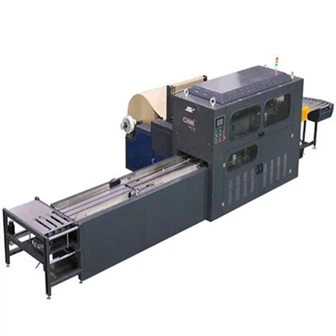
Some of our customers experienced packaging issues when using our A4 paper sheeting and wrapping machines, where the wrapping paper curled when wrapping A4 paper.


Our solutions are as follows:
1. If the paper curls toward the unprinted side, it means that the unprinted side has less moisture. We solve the curling problem of packaging paper by humidifying the unprinted side paper.
Solution video : https://youtu.be/OPYF8id5iD4


2. If the paper curls toward the printed side, it means that the printed side has less moisture. We solve the curling problem of packaging paper by heating the unprinted side paper.


CHM Machinery as the leading A4 paper production line and paper sheeter machine manufacturer in China. Contact us for your paper sheeting solution! (Ms.Flora)WhatsApp:008615229284782 Email:chm05@szchm.com
More articles on LinkedIn, welcome to subscribe to my newsletter.
#papercurling #paperindustry #print #printindustry #packaging #machine #papersheetingsolution #papertrader #papersupplier #paperconverter #papersheeter #papersheetermachine #A4paperproductionline #A4 #manufacturer