

Company Profile
CHM,Cheung Kong Machinery is a professional manufacturer of paper sheeter machines and the leading paper sheeting solution provider in China. Since established in 2004,our company adheres to the innovation system centered on user needs to drive the continuous development of the enterprise. The equipment adopts the advanced technologies of Taiwan, the Britain and Germany, and enjoys a certain brand awareness in the industry. In the future, Shenzhen Cheung Kong Machinery Equipment Co., Ltd. will continue to adhere to the business philosophy of "professional, single-minded and dedicated", constantly innovate and develop, and provide customers with better quality products and services.
Why Choose Us
Professional Team
The company has tens of thousands of square meters of factory buildings, with strong technical innovation heritage and has cultivated a large number of professional talents, and has the most complete production technical force and after-sales service team in the whole industry.
Factory
The three factories in Guangdong, Shandong and Jiangsu have a total area of nearly 140,000 square meters, becoming the world's second largest sheeting machine manufacturer with independent production capacity.
Our Certificate
CE certification;ECM international certification;ISO9001certification.
Advanced Equipment
Precision high speed sheeter;automatic paper sheeter machine;A3/A4/A5 copy paper sheet cutting machine;ream paper box wrapping machine;six-axis stacking machine.


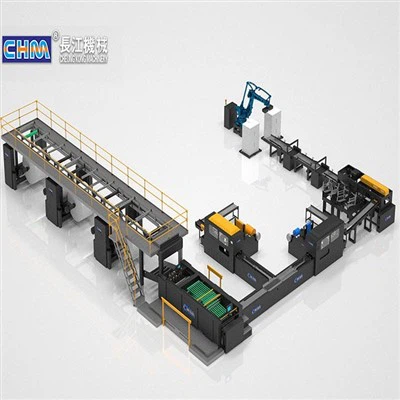


A4 paper packaging production line refers to a manufacturing system specially designed for the production and packaging of A4 paper or related paper products. It is a comprehensive installation that includes various machines, equipment and processes to efficiently produce, assemble and package A4 paper.
The main objective of the A4 paper packaging line is to automate the manufacturing process, increase productivity, ensure consistent quality and optimize the packaging of A4 paper products. Production lines typically include tasks such as cutting, folding, gluing, binding, packaging and quality control.
Benefits of Paper Packaging Production Line Equipment
Customized packaging
Dedicated A4 paper packaging production line can accurately produce packaging materials suitable for A4 size paper products. This ensures optimal protection and presentation of the paper.
Efficient Production
These lines are designed to simplify the manufacturing process and maximize efficiency and yield. Automated systems and machinery can handle various stages of production, including cutting, folding, gluing and sealing, reducing manual labor and increasing productivity.
Flexibility
A4 paper packaging lines are usually designed to accommodate different packaging designs and materials. They can be adapted to produce various types of packaging options such as boxes, cartons, sleeves or envelopes, offering the flexibility to meet specific packaging requirements.
Quality Control
These lines incorporate quality control mechanisms to ensure consistent and reliable packaging output. Inspections and tests can be carried out at different stages of the production process, ensuring that packaging materials meet the required standards in terms of size, durability and appearance.
Increased speed and output
The automated nature of the production line allows for faster production cycles, thereby increasing output. This is especially beneficial for meeting high-volume demands and ensuring timely delivery of packaging materials.
Type of Paper Packaging Production Line Equipment
Box or Carton Machines
Box and carton packaging machines are crucial in various industries, handling packaging tasks ranging from individual product cartons to larger shipping boxes. These machines are adaptable to the needs of both large-scale industries, where automation speeds up production, and smaller businesses, which may opt for semi-automatic or manual machines.
Box Erecting
Box and carton erecting machinery constructs boxes, skillets, and trays from blank or pre-cut forms. The automation system machine selects a form from a stack, assembles the box using pre-cut tabs and slots, and inserts internal dividers. The box is then sealed by applying adhesive or activating pre-applied glue on the seams.
Box Sealing or Tape Machine
After being filled with products, box-sealing machines prepare the boxes for labeling and shipping. These machines employ staples, big sealing tape, or adhesive to close the boxes securely.
Custom Box Cutting Machines
Custom box-cutting machines are automated systems that calculate the optimal box size for a product, cut and shape corrugated cardboard accordingly, and seal it around the product.
The working principle of the paper packaging production line is to use packaging machines with different functions, connected by conveyor belts, to package the products in one stop, and complete the process from product to packaged product to product for sale. The packaging scale in the packaging production line is manually operated, and the bags are manually sent to the automatic heat sealing machine for heat sealing. Then the bags are flattened by the bag leveling machine and sent to the semi-automatic coder for manual palletizing. The most commonly used packaging production line is generally composed of single machines such as bottle unscrambler, ultrasonic bottle washer, dryer, magnetic pump filling machine, capping machine (capping machine), light inspection machine, labeling machine, etc. The working principle of the filling machine is: first, the boxes with empty bottles are stacked on the pallet, and sent to the unloading pallet machine by the conveyor belt. The pallets are unloaded one by one, and the boxes are sent to the unloading box machine with the conveyor belt. The conveyor belt sends the empty boxes to the box washer, which is cleaned and then transported to the cartoning machine.

The preparation and the cleansing of the pulp
This untwists the fibers. Beating is a mechanical treatment intended for swelling, fibrillating and shortening the fibres. The result is a better sheet formation and the development of paper’s mechanical properties.
Before sending to the paper machine
The pulp is initially purified, diluted and air bubbles are eliminated. Sometimes pulp is also bleached if made from recycled paper.
The wet-end part
Raw material fibres and chemicals (and 99% of the water) are pumped to the head box, which feeds the stock evenly onto the wire section. This is a woven plastic mesh conveyor belt that can be 35 metres long and up to 10 metres wide. As the paper stock flows from the head box onto the wire, the water drains away through the mesh leaving small fibres as a mat on top of the mesh. The paper machine can travel at speeds of up to 2000 m/minute and by the time the paper stock has travelled half way down the wire, a high percentage of water has drained away. By the time the thin mat of fibres has reached the end of the wire section, it has become a sheet of paper, although very moist and of little strength.
The press section
This section consists of a number of sets of felts and heavy cylinders through which the moist paper web passes. More water is pressed out to felts and drawn away by suction. Pressure binds the fibres together and consolidates the web.
Dryer
This section consists of a large number of steam-heated drying cylinders which have a temperature of slightly over 100°C. Synthetic drier fabrics carry the paper web round the cylinders until the paper is dry.
Coating/Calendering
In many applications, the surface of the sheet needs improvement in order that any characters imposed on the sheet be legible. This is achieved by calendering, a process
which reorients the surface fibres in the base sheet of paper (or the coating applied to the surface) by the use of pressure. This serves to smooth the surface, control surface texture and develop a glossy finish. Such papers are known as machine finished.
Finishing
At the end of the drying process, the sheet is smoothed using an “ironing” method, which consists of hot polished iron rollers mounted in pairs with synthetic material rollers, one above the other. This also helps to consolidate, polish and glaze the surface of the paper: the characteristics of the surface of the sheet are improved.
Shipping
Still travelling at very high speeds, the paper comes off the machine ready for reeling up into large reels (called parent reels), which can be cut or slit into smaller ones, according to customer requirements. These large reels are produced and changed without any interruption of the production process.
Quality control
Sensors and computers verify parameters such as the production speed, the pressure, and the resistance at every step of the process to ensure that the paper or board is of a consistently high quality. Moreover, for food contact applications, microbiological, chemical and organoleptic controls have to be carried out.
A Typical A4 Paper Packaging Line Consists of Different Machines and Components Including:
Raw Material Handling Systems: These systems handle the loading, storage and feeding of raw materials, such as jumbo rolls or A4 paper.
Printing and cutting machines: These machines perform printing tasks such as adding logos or branding to paper and precisely cutting paper into standard A4 size.
Folding and collating machines: These machines fold sheets into the desired format, such as booklets or booklets, and arrange multiple sheets in the correct order when required.
Gluing and binding machines: These machines make pockets, envelopes or binding covers and assemble booklets using adhesives.
Packing and wrapping machines: These machines pack finished A4 paper products for distribution or shipment using methods such as plastic film wrapping, shrink wrapping or placing them in boxes or cartons.
Quality control system: Throughout the production line, various quality control measures are implemented, including visual inspection, automatic inspection and sampling test.
Automation and conveyor systems: Automation and conveyor systems are used to streamline workflow, transfer paper between machines and minimize manual handling.
Control and monitoring system: The centralized control system supervises and regulates the operation of individual machines, the flow of materials, and the synchronization between different processes.
How to Maintenance Paper Packaging Production Line Equipment
Start-up preparation
Before starting the machine, the operator should conduct necessary inspections to ensure that the machine equipment and working environment meet safety requirements. At the same time, check whether the packaging materials are sufficient and whether the conveyor belt and control system of the packaging line are operating normally.
Packaging material preparation
The operator should prepare appropriate packaging materials, including cartons, plastic bags, labels, etc., according to the characteristics and packaging requirements of the product. Before using a new batch of packaging materials, check their quality and integrity to ensure that there is no damage or contamination.
Check product quality
Before the product enters the packaging line, the operator should conduct a quality inspection on the product to ensure that the product meets the prescribed quality standards. If a problematic product is found, the relevant department should be notified in time and handled in accordance with the prescribed procedures.
Packaging operation
When performing packaging operations, the operator should follow the operating procedures, operate the packaging equipment correctly, and place the product in the appropriate position. Pay attention to keeping the packaging materials and products clean to avoid affecting the quality of the product due to contamination.
Machine and equipment maintenance
The machine and equipment of the packaging line need to be regularly maintained and maintained to maintain its normal operation and extend its service life. Operators should check and clean the equipment regularly and replace worn parts in time according to the requirements of the equipment maintenance manual.
Waste disposal
During the packaging process, some waste or defective products may be generated. These wastes should be classified, collected and disposed of according to the company's waste disposal system. Operators should operate waste disposal equipment correctly to ensure environmentally friendly disposal of waste.
Our Factory
The three factories in Guangdong, Shandong and Jiangsu have a total area of nearly 140,000 square meters, becoming the world's second largest sheeting machine manufacturer with independent production capacity.


FAQ
We're professional paper packaging production line equipment manufacturers and suppliers in China, specialized in providing high quality customized service. We warmly welcome you to buy paper packaging production line equipment for sale here and get quotation from our factory.
machinery for paper packaging production, production line for large scale paper packaging, customized paper packaging production line